The ternary operator in PHP provides a concise way to write an if-else statement, allowing you to assign a value based on a condition using only one line.
Where a standard if/else block might take four lines, a ternary does the same job in one. The name comes from the fact that it takes three operands: a condition, a value for true, and a value for false.
The syntax looks like this:

If the condition is true, the first value is returned; otherwise, the second value is returned.
A real example makes it easier to understand:
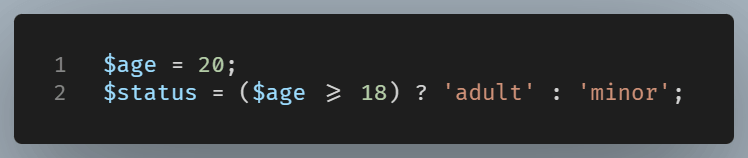
PHP checks the condition, picks the matching value, and assigns it.
Where are ternary operators helpful ?
Ternary operators are very useful in cases where the logic is simple and the intent is obvious. Setting a default label, toggling a CSS class, or deciding which message to show are some of these cases.
Using it makes code stay readable without the complexity of a full conditional block.
A few common use cases:
- Displaying a fallback value when a variable might be empty
- Assigning one of two CSS classes based on a condition
- Choosing between two short string values
The shorter version (and when to use it)
PHP also supports a compressed form called the Elvis operator. It drops the middle operand entirely:
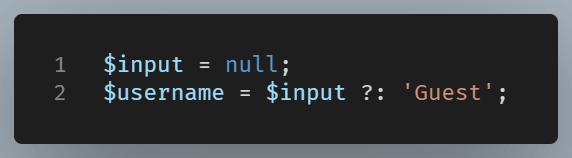
If $input is truthy, then it it is the used condition; otherwise, 'Guest' is the fallback.
It’s a clean pattern for default values, implemented in a lot of codebases.
It is a very useful pattern for setting default values.

Limitations worth knowing
Ternary operators are not always the right tool. Nesting them — putting one inside another — produces code that is technically valid but genuinely hard to read:

At that point, a standard if/else block is a better choice. Readability matters more than brevity; a shorter line that confuses the next developer (or you, three months later) is not an improvement.
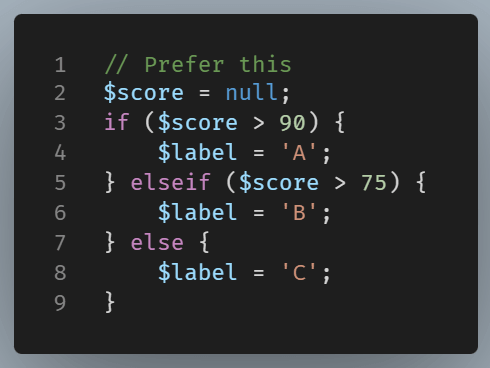
Each condition gets its own line, the flow reads top to bottom, and cognitive load is reduced.
Conclusion
The ternary operator is a practical feature of PHP. It is great for handling simple conditions without the need for a lengthy if/else structure. Familiarize yourself with its syntax, apply it when the logic is clear, and choose a different approach when the situation becomes more complicated.