As Python programs grow, writing everything as separate variables and functions quickly gets messy. Classes solve this problem by grouping data and behavior together.
Thinking in Terms of Blueprints
Classes act as blueprints for creating Objects.
A class defines what something should look like and what it should be able to do. The class itself is not a tangible entity that you interact with. Instead, it describes how objects created from it should behave.
Here is a simple class definition:
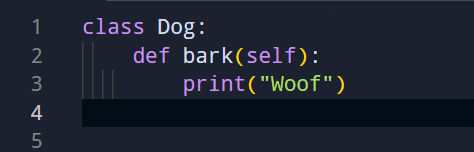
This class describes a dog. It says that every dog object should be able to bark.
Creating Objects From a Class
An object is an instance of a class. It is the real usable thing created from the blueprint.
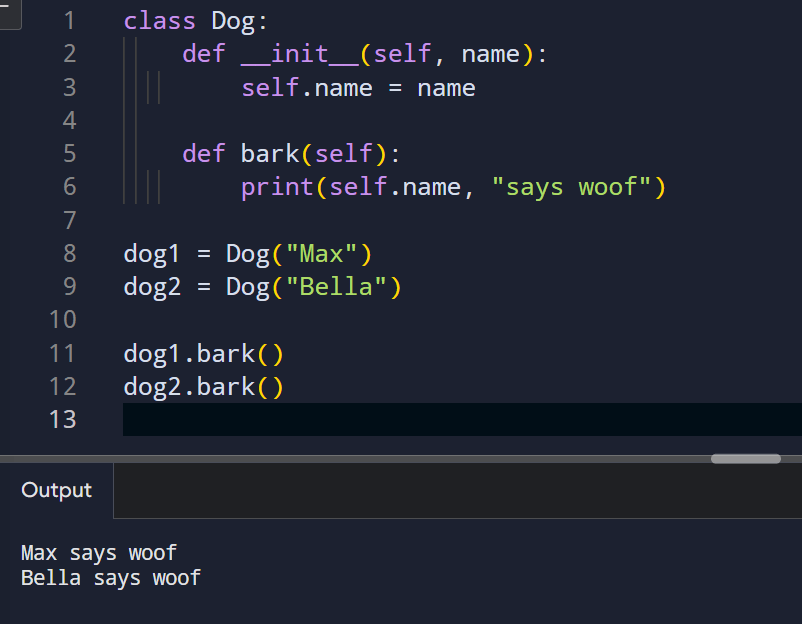
Here, both dog1 and dog2 are objects. They were created using the Dog class. This class defines both data and behavior for dog objects. The object can call the bark method (line 5) because that behavior was defined in the class.
Let’s dissect the example:
1. The Class Definition
class Dog:
This line creates a new class named Dog.
classis the keyword that tells Python you are defining a class.Dogis the class name, written in capitalized form by convention.
At this point, nothing is created yet. You are only defining a blueprint.
2. The __init__Method
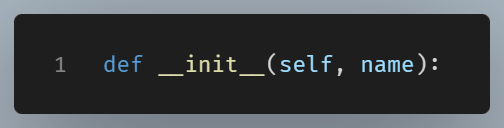
This method runs automatically when a new object is created from the class.
__init__is called the initializer- It prepares the object for use.
selfrefers to the current object instance (we could use any keyword butselfis a common approach).nameis data passed in during creation
3. Storing Data With self
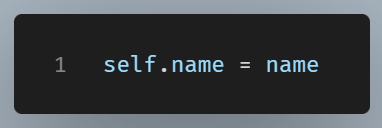
This line attaches data to the object.
self.namecreates an attribute called name.- name on the right is the value passed in.
Each object gets its own name value.
Example:
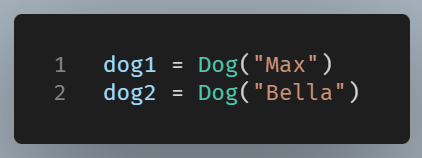
dog1.name is “Max”
dog2.name is “Bella”
The objects share the same structure but hold different data.
4. The bark Method
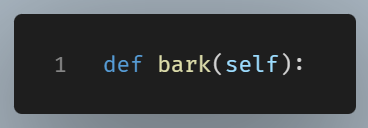
This defines a method that belongs to the class.
- Methods describe what an object can do.
selfgives the method access to the object’s data.
5. Using Object Data Inside a Method
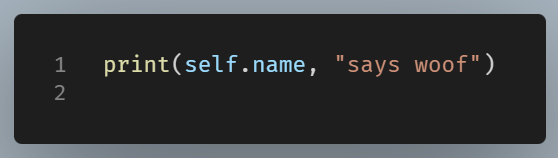
This line uses the object’s stored data.
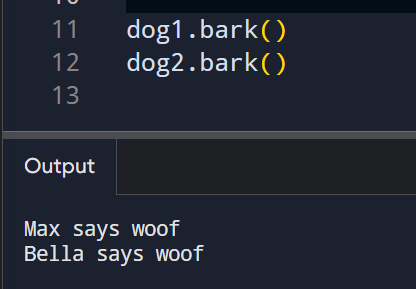
self.nameretrieves the name of the current object.- The output changes depending on which object calls the method.
Example:
Key Takeaways
- The
classdefines structure and behavior. __init__prepares each object.selfrefers to the current object instance.- Attributes store data.
- Methods act on that data.
Class Versus Object
The difference between a class and an object is simple once you see it in action.
- A class serves to define the structure and behavior of object instances.
- An object holds actual data and uses that behavior.
By writing just one class (one blueprint) you can create many objects. This keeps code organized and avoids repetition.
Wrapping It Up
Classes are the manifestation of real ideas into blueprints. Users, products, files, or messages are some of these ideas and all can all be represented as objects following the structure dictated by the class.
Each object maintains its own state while adhering to rules defined by the class. This approach keeps programs readable and easy to extend.