Stateless REST APIs have become the architectural default for modern web applications. But default doesn’t mean universal. While stateless systems offer clear benefits for scaling, and simplicity, they’re not always the best fit for every situation.
Statelessness means the server doesn’t remember anything between requests, which sometimes forces the client to include a lot of information. This can increase request size, add repetition, and place more responsibility on the client to track its own state.
For example:
- Systems that require multi-step workflows may need extra design work because each step must be fully described in every request.
- Applications with frequent user interactions — like shopping carts — traditionally required stateful servers to track items across requests. While modern implementations often work around this by storing cart state in the client (browser storage, JWT tokens), this shifts complexity to the client side and requires careful handling of synchronization and security.
- If servers need to verify identity constantly, statelessness can lead to many repeated authentication checks, unless solutions like tokens are used to manage this efficiently.
In other words, statelessness simplifies the server but can shift complexity somewhere else. It’s a trade-off, and choosing it depends on how your application behaves and what it needs to store over time.
Short Diagram Reminder
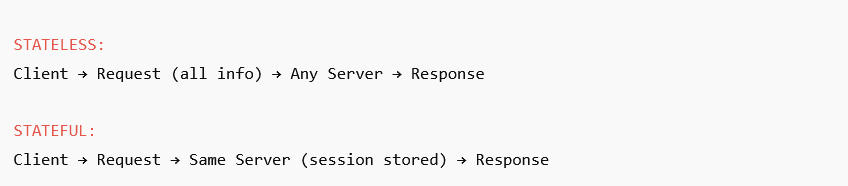
When to Choose Stateless vs. Stateful Systems
Choosing between stateless and stateful design depends on what your application needs to remember, how it handles user interactions, and the level of complexity you’re ready to manage.
Choose Stateful When:
1. A workflow spans multiple steps
Shopping carts, multi-page checkouts, survey builders, and onboarding flows often need the server to remember user progress.
2. Server-side decisions rely on previous actions
For example, a game server that tracks player location or a chat server that tracks presence.
3. You want to avoid sending too much repeated data
If every request would otherwise require large or sensitive data, storing it on the server can be more efficient.
4. Real-time interactions require continuity
Stateful systems help when the server and client must maintain long-lived connections or track a consistent session.
Typical examples:
Online shopping carts, dashboards with live sessions, real-time apps (chat, games), financial systems that manage long-lived transactions.
Choose Stateless When:
1. You expect high traffic and need easy scaling
Any server can handle any request, making it easy to add more servers during peak load.
2. Requests can stand on their own
If each request can describe everything the server needs , such as a token, an ID, or parameters, statelessness works well.
3. The client can manage its own state
Browsers, mobile apps, or client-side frameworks are good at storing temporary data (tokens, preferences, progress).
4. You want simpler server logic
We don’t have session storage, session syncing, or cleanup jobs in place. The server also doesn’t store any user-specific memory.
Typical examples:
Public APIs, REST endpoints, microservices, authentication via tokens, content APIs, search endpoints.
Visual Comparison Table
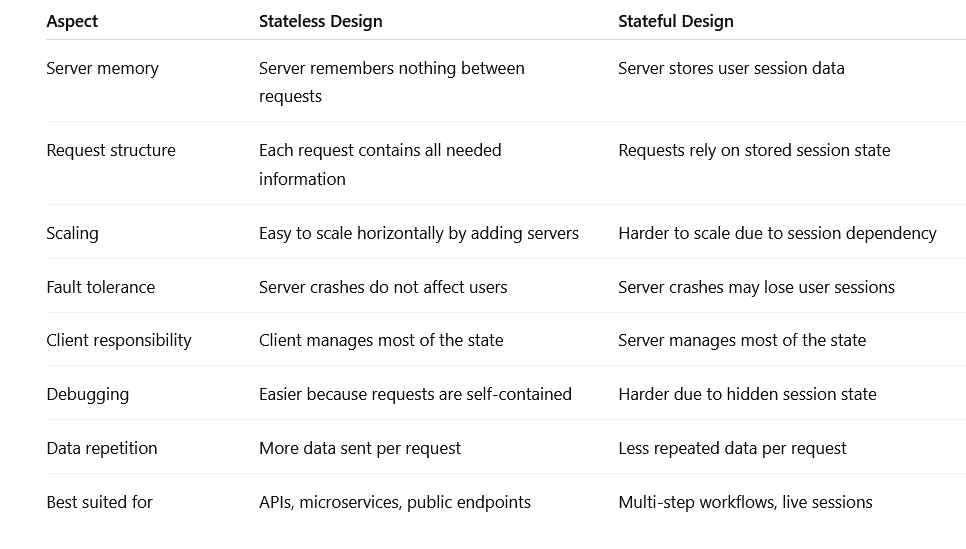
Below is a clean visual comparison table you can drop directly into your article. It’s designed for beginners and makes the trade-offs easy to scan and remember.
Stateless vs. Stateful Systems at a Glance
Making sense of this table
Reading this table reveals a pattern: stateless design trades increased request overhead for operational simplicity and easy scaling. Stateful design does the opposite. It reduces request overhead but increases operational complexity.
In basic terms, a stateless approach places the responsibility on the client, while a stateful approach assigns that responsibility to the server.
The choice you make will depend on which trade-off better fits your system’s priorities: do you value operational simplicity more, or is communication efficiency your main concern?
Neither approach is “better” in all cases. Each solves a different problem.
Simple Rule of Thumb
Choose Stateful if: Your application works like an ongoing conversation where the server must remember context between interactions.
Choose Stateless if: Your application works like a series of independent questions where each request contains everything needed to respond.
The right choice depends on whether user interactions build on each other or stand alone.
Real-World Hybrid Example
Modern systems often blend both approaches. For example:
Netflix uses stateless APIs for content delivery (any server can serve video metadata) but stateful systems for streaming playback (tracking exactly where you paused requires continuity). This hybrid approach maximizes the benefits of each pattern.
NOTE: If you're building a new system, starting stateless is often easier—you can add stateful components later if needed. Converting a stateful system to stateless is much harder because it requires redesigning how context is managed.
Conclusion
Stateful and stateless designs each solve different problems.
Before choosing state, ask yourself: Do my users’ requests depend on previous interactions? Will I benefit more from server simplicity or from maintaining server-side context? There’s no universal answer. But only the right answer for your specific use case.
When building your next system, resist the temptation to follow patterns blindly.
Good system design is about choosing the right tool for the job, not following a single rule everywhere.
Evaluate your application’s actual needs, understand the pros and cons, and choose the approach that aligns with your scaling requirements, and user experience goals.